The check gets written the day you go under contract. It goes straight to the seller, not to an escrow account, and the moment both signatures land on the North Carolina Offer to Purchase and Contract, that money belongs to them. Not the earnest money. The due diligence fee. North Carolina is the only state that runs its residential contracts this way, and the fee buys you exactly one thing: the right to walk away for any reason before your due diligence period ends. It does not buy you a refund if your inspector finds something ugly. That part surprises almost every buyer who learned the contingency system somewhere else.
Most guides to this stop right there, with the mechanics. What they skip is the part that actually changes your strategy in Durham: the citywide numbers everyone quotes to justify an aggressive, fast due diligence structure describe a market that barely exists once you cross into the neighborhoods carrying the city's oldest wiring and plumbing. Durham reports its market as one number. It behaves as at least two.
One City, Two Markets
Over the three months ending in June 2026, Durham homes sold in roughly 28 days on average, with typical listings fielding about two offers, according to Redfin's tracking. That is the number that gets repeated in every relocation guide and every buyer's-agent pitch: Durham moves fast, come ready to compete.
Trinity Park tells a different story with the same data source. In March 2026, homes there sold after an average of 146 days on the market, up from 136 days the year before, and only five homes sold that entire month. Redfin's separate competitiveness metric puts typical Trinity Park sales closer to 61 days, still more than double the citywide pace. Either figure points the same direction: this is a thin, slow-moving market, not a bidding-war market, and five sales in a month is too small a sample to treat any single median price as reliable.
That distinction matters because the due diligence playbook built for citywide speed, a short period paired with a large fee to signal seriousness, assumes a seller who has other offers stacking up behind you. In Trinity Park, Old West Durham, and Forest Hills, that assumption often does not hold. Sellers in these pockets are frequently working with one offer, not five, which changes what a buyer needs to concede to win the house.
What a 90-Year-Old House Actually Tests
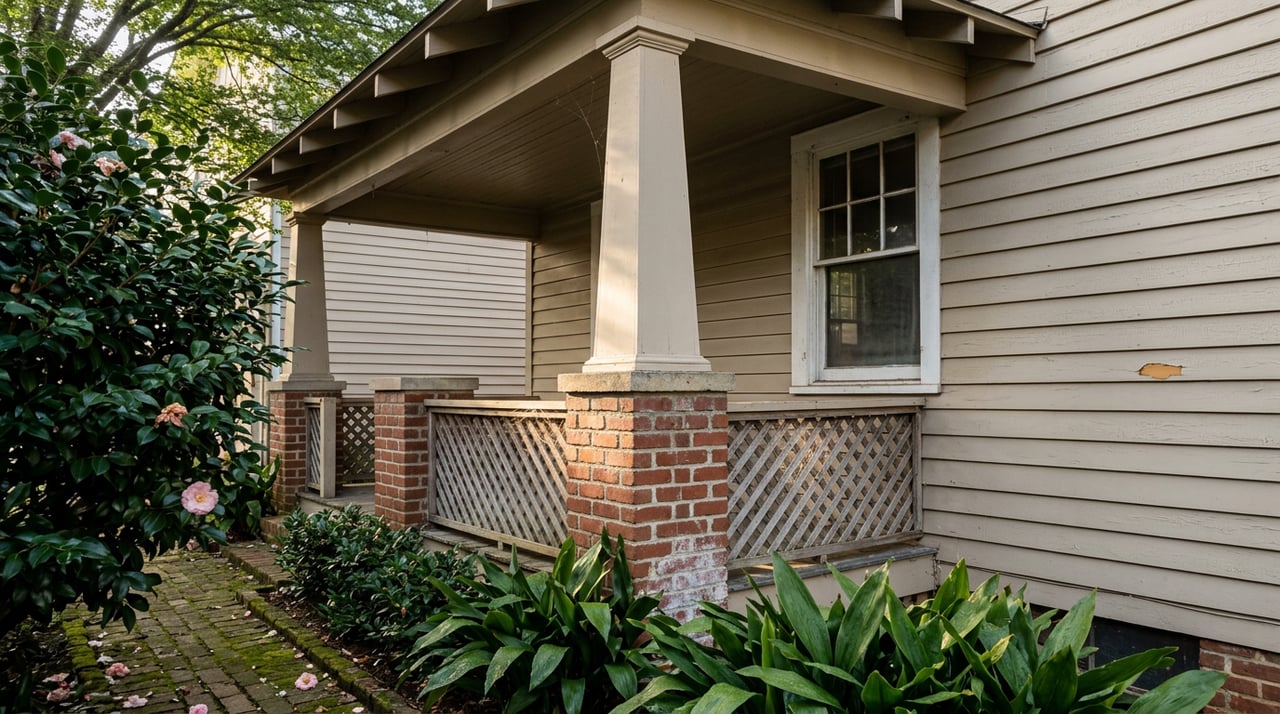
The reason this matters is not abstract. City Home Inspections, which works across Durham County every week, describes a consistent pattern in the older sections closer to downtown: original knob-and-tube wiring remnants, cast iron plumbing nearing the end of its service life, and roof valleys and dormers steep enough that the firm brings in drone imaging rather than walk the shingles. Durham County also sits in a moderate radon zone, and levels vary enough by lot and foundation type that a county average tells a buyer almost nothing about the specific house in front of them.
These are not hypothetical risks scattered evenly across the city. They cluster in exactly the neighborhoods where the sales pace is slowest: Trinity Park and Old West Durham for early-1900s construction, Forest Hills for its 1930s-era homes built around the namesake park, and Woodcroft and Parkwood carrying their own mix of later-era systems. Advantage NC Home Inspection, which covers Hope Valley, Southpoint, Trinity Park, and Woodcroft among other Durham communities, lists standard inspections running $475 to $550 and taking two to three hours, with radon testing, sewer scope, and termite inspection offered as add-ons rather than defaults, precisely because not every house needs all three, but an early-1900s bungalow usually does.
If the home was built before 1978, there is a separate federal layer to plan for: contractors doing renovation work that disturbs paint on a pre-1978 property are required to follow lead-safe work practices, and vinyl floor tile, old pipe insulation, and textured ceilings installed before the 1980s are common places asbestos turns up. None of this shows up in a standard walk-through inspection. It requires asking for it.
The Fee Doesn't Care What the Inspector Finds
Once you're past your due diligence date, the leverage flips completely, and it flips regardless of what a report says.
The North Carolina Real Estate Commission is specific about when a due diligence fee actually comes back: essentially, only if the seller materially breaches an obligation under the contract, or if the property is destroyed or materially damaged before closing. A cracked cast iron stack, a knob-and-tube circuit still live behind a wall, a radon reading above the action level, none of that triggers a refund on its own. It gives you the standing to renegotiate or terminate before your deadline, but the fee itself is gone the moment you signed, win or lose.
That is the detail that makes the neighborhood-level slowdown useful rather than just interesting. A buyer who structures a Durham offer around the citywide 28-day pace is often building in barely enough runway to get a standard inspection done, let alone a sewer scope, an electrical panel evaluation, and a radon test on a house that statistically needs all three. A buyer working a Trinity Park or Forest Hills listing, where the seller may have been waiting months already, generally has more room to ask for the time that older systems actually require.
Sizing the Fee to the House, Not the City
In Durham's genuinely competitive in-town listings, the aggressive structure still works: a short due diligence period, sometimes as tight as three to five days, paired with a due diligence fee that has recently run somewhere in the $2,000 to $10,000 range for single-family homes, occasionally higher on a hard-fought listing. That combination signals to a seller fielding multiple offers that you're serious and fast.
That same structure is often the wrong tool once the house in question is a century-old bungalow with a thin buyer pool behind you. The more useful shape there tends to land closer to the 14 to 30 day due diligence periods that are typical across the wider Triangle, giving enough time to schedule specialty inspections in sequence rather than racing them. The fee itself can often stay moderate, since a seller with one offer on the table in month four has less pricing power to extract a premium for speed.
There is also a broader shift worth factoring in. During the 2021 to 2023 run, Triangle buyers were routinely offering due diligence fees of $25,000 or more just to be competitive. That era has passed. The 2026 market has moved back toward buyers in most situations, which means the negotiating room to ask for a longer period without torching your offer's credibility is wider than it's been in several years.
A due diligence period built for an older Durham home is worth using for more than the standard inspection:
- A full home inspection, ideally with an inspector who names Durham's older neighborhoods among their regular work
- A radon test specific to the property, not a county-level estimate
- A sewer scope, particularly relevant where cast iron lines are original
- An electrical evaluation focused on panel capacity and any remaining knob-and-tube
- Lead paint and asbestos testing if the home predates 1978 and renovation is part of the plan
A Few Practical Questions
Does the due diligence fee ever come back? Only in narrow circumstances: a material seller breach of contract, or destruction or major damage to the property before closing. An inspection turning up bad news does not trigger a refund on its own, though it can be grounds to renegotiate or terminate before your deadline.
Is a longer due diligence period a sign of weakness in an offer? Not in a market where the seller has limited alternatives. In Durham's slower in-town pockets, a well-reasoned 21 or 30-day period built around real inspection needs reads as prepared, not hesitant.
Do I need to test for radon if the inspector doesn't flag anything? Radon isn't something a standard walk-through inspection detects. Durham County's moderate radon zone means levels can differ meaningfully between two houses on the same street, so a lot-specific test is the only way to know.
Structuring a due diligence period around what a specific Durham house is likely to need, rather than what the citywide market average suggests, is exactly the kind of contract detail that rewards having a background in it. That's where Erica Berry spends her time with clients, drawing on a former career in corporate law to size due diligence terms to the actual property instead of a generic template. If you're weighing an offer on an older Durham home and want to talk through what the fee and timeline should look like for that specific address, Let's Connect.